Bird guide · Auriparus flaviceps
Verdin
What the verdin eats, where it lives, when it comes to feeders and how to recognise it – with sightings from every US state.
- Season
- Year-round resident
- Size
- 4.5 in (11.5 cm)
- Eats
- nectar (sugar water)
- Feeds
- nectar feeder
- Most common
- Arizona, Nevada, New Mexico
Food
What do verdins eat?
At feeders, verdins take nectar (sugar water).
Comes to hummingbird feeders for sugar water.
Feeder that suits it
A hummingbird nectar feeder with one part sugar to four parts water.
Range
Where do verdins live?
Brushy desert valleys and mesquite of the Southwest, also suburbs of some southwestern towns. By share of all bird sightings, verdins are most common in Arizona (2.0%).
States where verdins are most common
- Arizona2.0%
- Nevada1.4%
- New Mexico0.3%
- Utah0.2%
- Texas0.2%
- California0.08%
- Oklahoma0.00%
Share of all bird sightings in each state that are verdins, 2019–2024.
Season
Does the verdin migrate?
Year-round resident. Across the US it is reported in every month; its share of bird sightings is highest in March.
Share of all bird sightings in the US that are verdins, by month.
Identification
How to identify the verdin
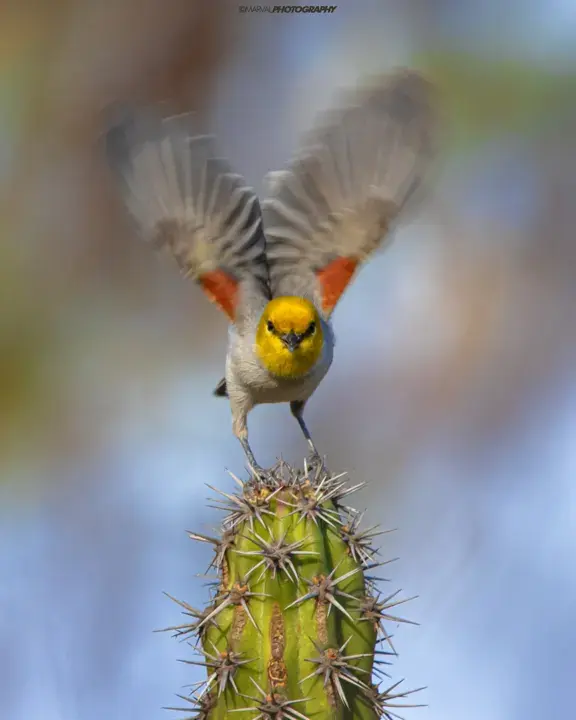
Adults: Very small, mostly grey and long-tailed, with some yellow on the head and red on the shoulder (often hidden).
Young birds: Plain grey.
Size: 4.5 in (11.5 cm)
Easily confused with
- Bushtit – juvenile Verdin has a pale bill base and is never in flocks
On camera
Getting the verdin on a feeder camera
You need a hummingbird feeder camera – hummingbirds never visit seed feeders. See feeder cameras compared for the nectar models.
Questions
Verdin: questions
What do verdins eat?
At feeders, nectar (sugar water).
Do verdins migrate?
Year-round resident. Across the US it is reported in every month; its share of bird sightings is highest in March.
Where do verdins live?
By share of all bird sightings, they are most common in Arizona, Nevada, New Mexico, Utah, Texas. They are rare or absent in Alabama, Alaska, Arkansas, Colorado, Connecticut, Delaware.