Bird guide · Icterus cucullatus
Hooded Oriole
What the hooded oriole eats, where it lives, when it comes to feeders and how to recognise it – with sightings from every US state.
- Season
- Migrant (March to August); a few stay in winter near sugar-water feeders.
- Size
- 7.5 in (19 cm)
- Eats
- sugar water, fruit, seeds
- Feeds
- nectar feeder, fruit feeder
- Most common
- California, Arizona, Texas
Food
What do hooded orioles eat?
At feeders, hooded orioles take sugar water, fruit, seeds.
A common visitor to hummingbird feeders.
Feeder that suits it
A hummingbird nectar feeder with one part sugar to four parts water.
Range
Where do hooded orioles live?
Hot lowlands of the Southwest, often around palms. By share of all bird sightings, hooded orioles are most common in California (0.3%).
States where hooded orioles are most common
- California0.3%
- Arizona0.3%
- Texas0.09%
- Nevada0.08%
- New Mexico0.04%
- Utah0.02%
- Oregon0.00%
- Washington0.00%
- Louisiana0.00%
- Michigan0.00%
Share of all bird sightings in each state that are hooded orioles, 2019–2024.
Season
When can you see the hooded oriole?
Migrant (March to August); a few stay in winter near sugar-water feeders.. Across the US, sightings start in March, peak in July and fade out in September.
Share of all bird sightings in the US that are hooded orioles, by month.
Identification
How to identify the hooded oriole
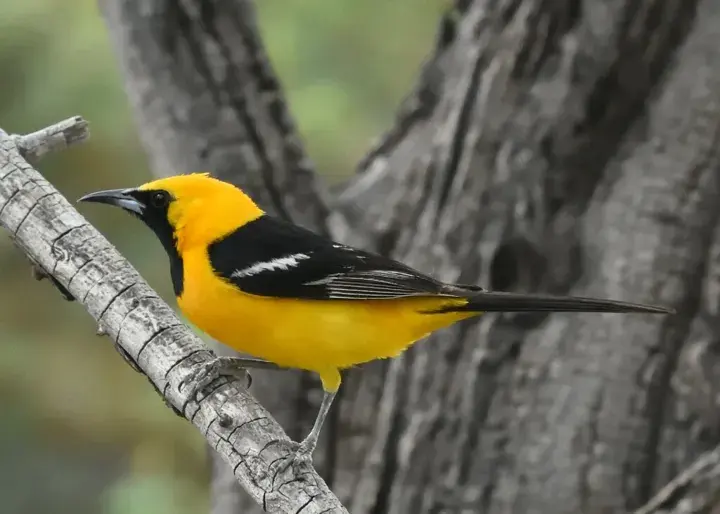
Male: Orange hood, black throat and back, white shoulder.
Female: Overall yellow-green with a thin, slightly curved bill.
Size: 7.5 in (19 cm)
On camera
Getting the hooded oriole on a feeder camera
You need a hummingbird feeder camera – hummingbirds never visit seed feeders. See feeder cameras compared for the nectar models.
Questions
Hooded Oriole: questions
What do hooded orioles eat?
At feeders, sugar water, fruit, seeds.
Do hooded orioles migrate?
Migrant (March to August); a few stay in winter near sugar-water feeders.. Across the US, sightings start in March, peak in July and fade out in September.
Where do hooded orioles live?
By share of all bird sightings, they are most common in California, Arizona, Texas, Nevada, New Mexico. They are rare or absent in Alabama, Alaska, Arkansas, Colorado, Connecticut, Delaware.
What does a female hooded oriole look like?
Overall yellow-green with a thin, slightly curved bill.