Bird guide · Psaltriparus minimus
Bushtit
What the bushtit eats, where it lives, when it comes to feeders and how to recognise it – with sightings from every US state.
- Season
- Year-round resident
- Size
- 4.5 in (11.5 cm)
- Eats
- suet
- Feeds
- suet cage
- Most common
- California, New Mexico, Oregon
Food
What do bushtits eat?
At feeders, bushtits take suet.
Travels in flocks of twenty or thirty that move from tree to tree in single file.
Feeder that suits it
A suet cage on a tree trunk or pole; peanuts and sunflower hearts work too.
Range
Where do bushtits live?
Woods and mountains of the western US. By share of all bird sightings, bushtits are most common in California (1.2%).
States where bushtits are most common
- California1.2%
- New Mexico0.9%
- Oregon0.7%
- Washington0.6%
- Colorado0.4%
- Nevada0.4%
- Arizona0.2%
- Utah0.2%
- Idaho0.04%
- Texas0.02%
Share of all bird sightings in each state that are bushtits, 2019–2024.
Season
Does the bushtit migrate?
Year-round resident. Across the US it is reported in every month; its share of bird sightings is highest in March.
Share of all bird sightings in the US that are bushtits, by month.
Identification
How to identify the bushtit
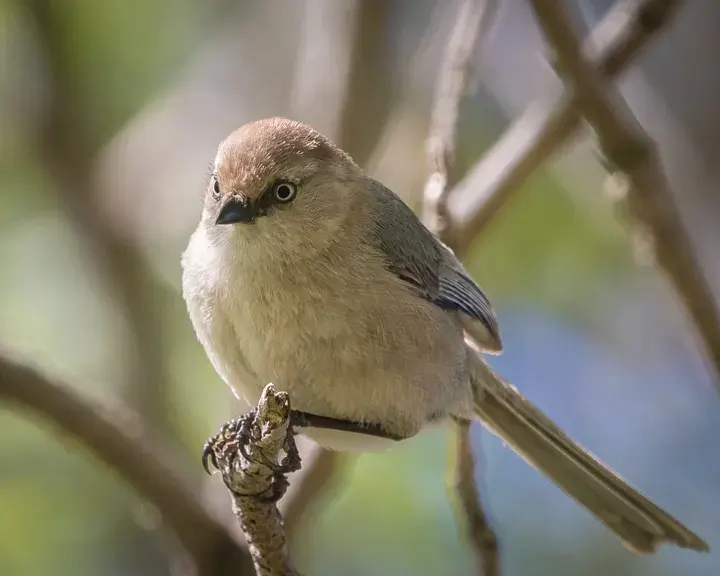
Adults: Tiny plain grey-brown bird with a small bill and long tail; males have dark eyes.
Size: 4.5 in (11.5 cm)
On camera
Getting the bushtit on a feeder camera
Pick a camera feeder that takes a suet cage, or mount a separate camera next to a suet feeder on the trunk – woodpeckers cling to the bark while they feed.
Questions
Bushtit: questions
What do bushtits eat?
At feeders, suet.
Do bushtits migrate?
Year-round resident. Across the US it is reported in every month; its share of bird sightings is highest in March.
Where do bushtits live?
By share of all bird sightings, they are most common in California, New Mexico, Oregon, Washington, Colorado. They are rare or absent in Alabama, Alaska, Arkansas, Connecticut, Delaware, District of Columbia.