Bird guide · Baeolophus atricristatus
Black-crested Titmouse
What the black-crested titmouse eats, where it lives, when it comes to feeders and how to recognise it – with sightings from every US state.
- Season
- Year-round resident
- Size
- 5.5 in (13.5 cm)
- Eats
- seeds, suet, nuts
- Feeds
- tube, hopper, suet cage
- Most common
- Texas, Oklahoma
Food
What do black-crested titmouses eat?
At feeders, black-crested titmouses take seeds, suet, nuts.
Opens seeds by holding them with its feet and pounding with its bill; stores food for later.
Feeder that suits it
A suet cage on a tree trunk or pole; peanuts and sunflower hearts work too.
Range
Where do black-crested titmouses live?
Southern and central Texas, barely into southwestern Oklahoma. By share of all bird sightings, black-crested titmouses are most common in Texas (0.9%).
Season
Does the black-crested titmouse migrate?
Year-round resident. Across the US it is reported in every month; its share of bird sightings is highest in February.
Share of all bird sightings in the US that are black-crested titmouses, by month.
Identification
How to identify the black-crested titmouse
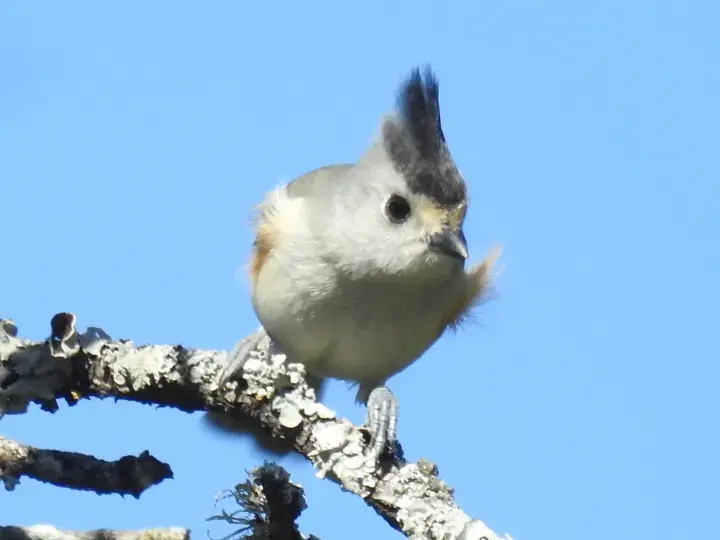
Adults: Grey and white with a black crest, white forehead and orange-tinged flanks.
Size: 5.5 in (13.5 cm)
Easily confused with
- Tufted Titmouse – grey crest and black forehead
Nesting
Does the black-crested titmouse use nest boxes?
Yes. Entrance hole 1 1/4 in (32 mm) per NestWatch.
On camera
Getting the black-crested titmouse on a feeder camera
Pick a camera feeder that takes a suet cage, or mount a separate camera next to a suet feeder on the trunk – woodpeckers cling to the bark while they feed.
Questions
Black-crested Titmouse: questions
What do black-crested titmouses eat?
At feeders, seeds, suet, nuts.
Do black-crested titmouses migrate?
Year-round resident. Across the US it is reported in every month; its share of bird sightings is highest in February.
Where do black-crested titmouses live?
By share of all bird sightings, they are most common in Texas, Oklahoma. They are rare or absent in Alabama, Alaska, Arizona, Arkansas, California, Colorado.