Bird guide · Zonotrichia leucophrys
White-crowned Sparrow
What the white-crowned sparrow eats, where it lives, when it comes to feeders and how to recognise it – with sightings from every US state.
- Season
- Migrant; some Pacific coast birds resident
- Size
- 6.1 in (15.5 cm)
- Eats
- seeds
- Feeds
- ground
- Most common
- Nevada, California, New Mexico
Food
What do white-crowned sparrows eat?
At feeders, white-crowned sparrows take seeds.
Winter flocks rummage on the ground near brushy thickets.
Feeder that suits it
A low tray or platform feeder, or seed scattered on the ground below your feeder.
Range
Where do white-crowned sparrows live?
Common in the West; uncommon migrant or winter bird in the East. By share of all bird sightings, white-crowned sparrows are most common in Nevada (2.1%).
States where white-crowned sparrows are most common
- Nevada2.1%
- California1.7%
- New Mexico1.7%
- Arizona1.4%
- Alaska1.4%
- Washington1.3%
- Utah1.3%
- Oregon1.2%
- Wyoming1.1%
- Idaho1.1%
Share of all bird sightings in each state that are white-crowned sparrows, 2019–2024.
Season
Does the white-crowned sparrow migrate?
Migrant; some Pacific coast birds resident. Across the US it is reported in every month; its share of bird sightings is highest in October.
Share of all bird sightings in the US that are white-crowned sparrows, by month.
Identification
How to identify the white-crowned sparrow
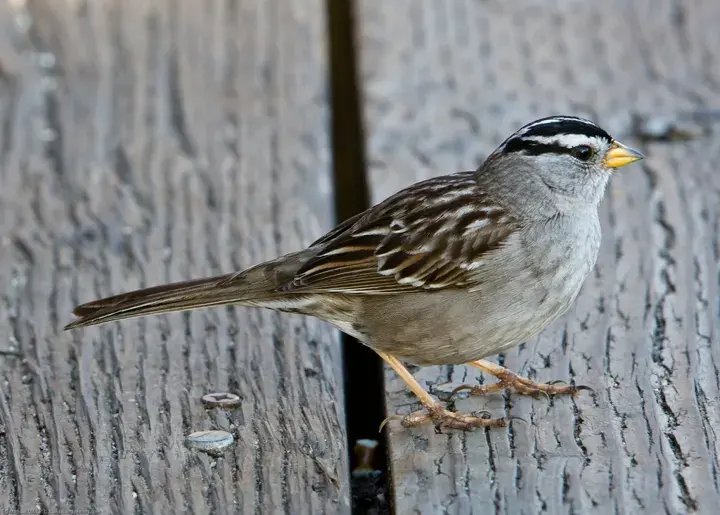
Adults: Bold black-and-white head stripes, pearly-grey breast and a pink, orange or yellow bill.
Size: 6.1 in (15.5 cm)
On camera
Getting the white-crowned sparrow on a feeder camera
Most visits happen on the ground or on low trays. A camera feeder with a wide tray, placed low near cover, catches far more than a hanging tube.
Questions
White-crowned Sparrow: questions
What do white-crowned sparrows eat?
At feeders, seeds.
Do white-crowned sparrows migrate?
Migrant; some Pacific coast birds resident. Across the US it is reported in every month; its share of bird sightings is highest in October.
Where do white-crowned sparrows live?
By share of all bird sightings, they are most common in Nevada, California, New Mexico, Arizona, Alaska. They are rare or absent in Florida, Hawaii, South Carolina.
More birds