Bird guide · Junco hyemalis
Dark-eyed Junco
What the dark-eyed junco eats, where it lives, when it comes to feeders and how to recognise it – with sightings from every US state.
- Season
- Partial migrant; most populations migrate.
- Size
- 6 in (15 cm)
- Eats
- seeds
- Feeds
- ground
- Most common
- Washington, Oregon, Alaska
Food
What do dark-eyed juncos eat?
At feeders, dark-eyed juncos take seeds.
Comes to feeders but tends to forage on the ground under the feeding tray.
Feeder that suits it
A low tray or platform feeder, or seed scattered on the ground below your feeder.
Range
Where do dark-eyed juncos live?
Winter flocks across much of the continent. By share of all bird sightings, dark-eyed juncos are most common in Washington (2.8%).
States where dark-eyed juncos are most common
- Washington2.8%
- Oregon2.4%
- Alaska2.1%
- Idaho1.9%
- New Mexico1.8%
- Vermont1.8%
- New Hampshire1.8%
- Colorado1.6%
- Utah1.5%
- Kansas1.5%
Share of all bird sightings in each state that are dark-eyed juncos, 2019–2024.
Season
Does the dark-eyed junco migrate?
Partial migrant; most populations migrate.. Across the US it is reported in every month; its share of bird sightings is highest in February.
Share of all bird sightings in the US that are dark-eyed juncos, by month.
Identification
How to identify the dark-eyed junco
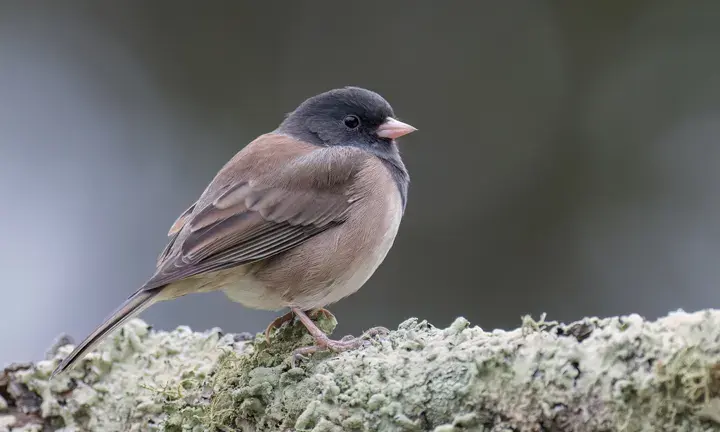
Male: Variable: slate-grey and white in the East, black hood with chestnut back in the 'Oregon' form; white outer tail feathers.
Female: Slightly browner (Slate-colored) or paler with a grey hood (Oregon).
Young birds: Streaky brown.
Size: 6 in (15 cm)
On camera
Getting the dark-eyed junco on a feeder camera
Most visits happen on the ground or on low trays. A camera feeder with a wide tray, placed low near cover, catches far more than a hanging tube.
Questions
Dark-eyed Junco: questions
What do dark-eyed juncos eat?
At feeders, seeds.
Do dark-eyed juncos migrate?
Partial migrant; most populations migrate.. Across the US it is reported in every month; its share of bird sightings is highest in February.
Where do dark-eyed juncos live?
By share of all bird sightings, they are most common in Washington, Oregon, Alaska, Idaho, New Mexico. They are rare or absent in Florida, Hawaii.
What does a female dark-eyed junco look like?
Slightly browner (Slate-colored) or paler with a grey hood (Oregon).