Bird guide · Sitta canadensis
Red-breasted Nuthatch
What the red-breasted nuthatch eats, where it lives, when it comes to feeders and how to recognise it – with sightings from every US state.
- Season
- Year-round resident; irruptive
- Size
- 4.5 in (11.5 cm)
- Eats
- seeds, suet
- Feeds
- tube, suet cage
- Most common
- Washington, Montana, Idaho
Food
What do red-breasted nuthatches eat?
At feeders, red-breasted nuthatches take seeds, suet.
Climbs up and down trunks head-first and may cache food items in bark crevices.
Feeder that suits it
A tube or hopper feeder with sunflower seed or sunflower hearts.
Range
Where do red-breasted nuthatches live?
Northern and mountain conifer forests; large southward invasions in some years. By share of all bird sightings, red-breasted nuthatches are most common in Washington (1.4%).
States where red-breasted nuthatches are most common
- Washington1.4%
- Montana1.4%
- Idaho1.3%
- Maine1.3%
- Vermont1.3%
- New Hampshire1.2%
- Oregon1.1%
- Wyoming1.1%
- Alaska0.9%
- South Dakota0.9%
Share of all bird sightings in each state that are red-breasted nuthatches, 2019–2024.
Season
Does the red-breasted nuthatch migrate?
Year-round resident; irruptive. Across the US it is reported in every month; its share of bird sightings is highest in September.
Share of all bird sightings in the US that are red-breasted nuthatches, by month.
Identification
How to identify the red-breasted nuthatch
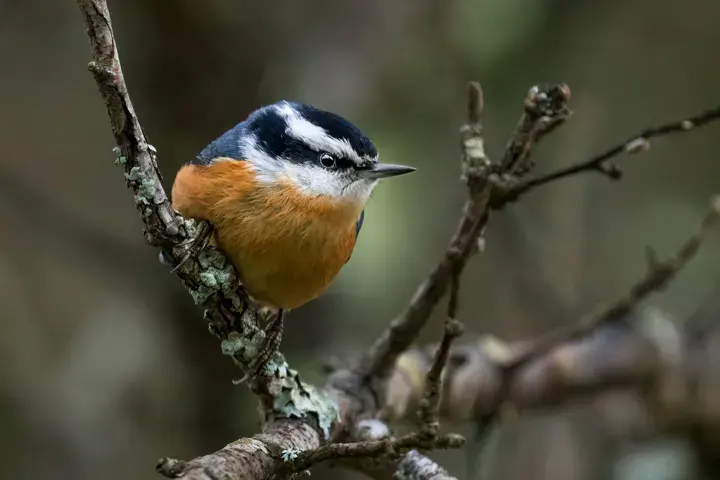
Adults: Black eye stripe, white eyebrow, buffy-orange underparts and blue-grey back.
Size: 4.5 in (11.5 cm)
On camera
Getting the red-breasted nuthatch on a feeder camera
Any seed camera feeder works. Hang it near shrubs for cover, about five feet off the ground, with the lens facing away from direct sun.
Questions
Red-breasted Nuthatch: questions
What do red-breasted nuthatches eat?
At feeders, seeds, suet.
Do red-breasted nuthatches migrate?
Year-round resident; irruptive. Across the US it is reported in every month; its share of bird sightings is highest in September.
Where do red-breasted nuthatches live?
By share of all bird sightings, they are most common in Washington, Montana, Idaho, Maine, Vermont. They are rare or absent in Florida, Hawaii.