Bird guide · Cardinalis cardinalis
Northern Cardinal
What the northern cardinal eats, where it lives, when it comes to feeders and how to recognise it – with sightings from every US state.
- Season
- Year-round resident
- Size
- 8.5 in (22 cm)
- Eats
- sunflower seeds, safflower seeds
- Feeds
- hopper, tray/platform, ground
- Most common
- Georgia, Kentucky, Arkansas
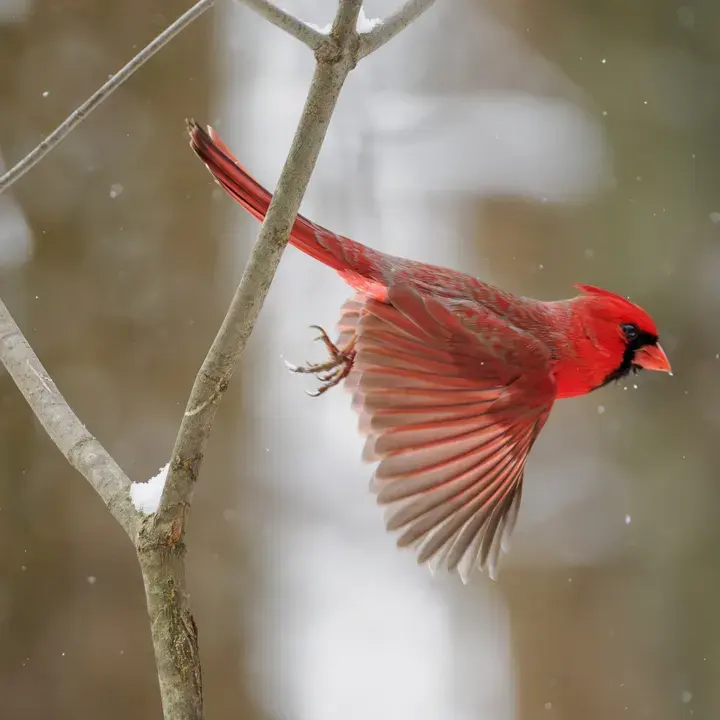
Food
What do northern cardinals eat?
Cardinals are seed eaters with a thick, cone-shaped bill that cracks shells easily. In the wild they eat seeds, berries and, in summer, insects, which they also feed to their young. At feeders they go for large seeds they can husk on a perch.
Forages mostly while hopping on the ground; favours sunflower seeds at feeders.
Feeder that suits it
A tray or platform feeder, or a hopper with a wide ledge. Cardinals are fairly large and like to face forward while they eat, so short perches on tube feeders suit them less.
Range
Where do northern cardinals live?
East and Southeast, north to southeastern Canada, locally in the desert Southwest; mostly absent west of the Great Plains. By share of all bird sightings, northern cardinals are most common in Georgia (4.4%).
States where northern cardinals are most common
- Georgia4.4%
- Kentucky4.2%
- Arkansas4.2%
- Missouri4.1%
- Alabama4.1%
- Tennessee4.1%
- Oklahoma3.9%
- South Carolina3.9%
- Virginia3.9%
- North Carolina3.9%
Share of all bird sightings in each state that are northern cardinals, 2019–2024.
Season
Does the northern cardinal migrate?
Year-round resident. Across the US it is reported in every month; its share of bird sightings is highest in February.
Share of all bird sightings in the US that are northern cardinals, by month.
Identification
How to identify the northern cardinal
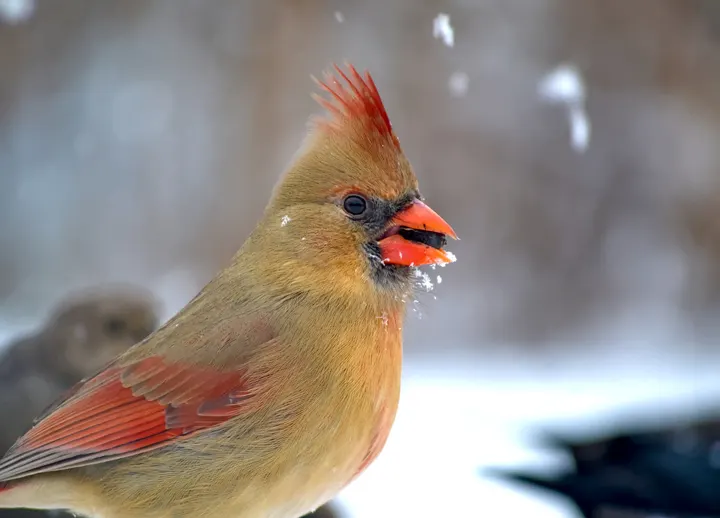
Male: Crimson red with a crest, a black face mask and a massive pinkish-red bill.
Female: Reddish-olive with a crest, a greyer, less defined mask and the same big pink bill.
Young birds: Like female but with a black bill at first.
Size: 8.5 in (22 cm)
Easily confused with
- Pyrrhuloxia – grey with a stubby yellow bill
- Tanagers – red but no crest
Photo: Timothy Lindsey / iNaturalist, CC BY
On camera
Getting the northern cardinal on a feeder camera
Cardinals are cautious and often visit early in the morning and late in the afternoon. A camera that records on motion around dawn and dusk catches most visits – check how the camera handles low light.
Choose a camera feeder with a wide tray or perch and fill it with sunflower or safflower. Hang it within a few metres of shrubs or a hedge, where cardinals feel safe, and at a height where the lens sees the tray, not the sky.
Because cardinals also feed on the ground, a second tray below the feeder often gets more visits than the camera feeder itself.
Questions
Northern Cardinal: questions
What do northern cardinals eat?
At feeders, sunflower seeds, safflower seeds. In the wild they eat seeds, berries and, in summer, insects, which they also feed to their young.
Do northern cardinals migrate?
Year-round resident. Across the US it is reported in every month; its share of bird sightings is highest in February.
Where do northern cardinals live?
By share of all bird sightings, they are most common in Georgia, Kentucky, Arkansas, Missouri, Alabama. They are rare or absent in Alaska, California, Colorado, Idaho, Montana, Nevada.
What does a female northern cardinal look like?
Reddish-olive with a crest, a greyer, less defined mask and the same big pink bill.