Bird guide · Passerina cyanea
Indigo Bunting
What the indigo bunting eats, where it lives, when it comes to feeders and how to recognise it – with sightings from every US state.
- Season
- Migrant
- Size
- 5.1 in (13 cm)
- Eats
- nyjer, millet, seed mixes
- Feeds
- tube, ground, tray/platform
- Most common
- Arkansas, Missouri, Kentucky
Food
What do indigo buntings eat?
At feeders, indigo buntings take nyjer, millet, seed mixes.
Takes seeds from the ground or stems; forages alone in summer and in flocks in winter.
Feeder that suits it
A tube or hopper feeder with sunflower seed or sunflower hearts.
Range
Where do indigo buntings live?
Breeds across the East on brushy edges; many cross the Gulf of Mexico on migration. By share of all bird sightings, indigo buntings are most common in Arkansas (1.2%).
Season
When can you see the indigo bunting?
Migrant. Across the US, sightings start in April, peak in July and fade out in October.
Share of all bird sightings in the US that are indigo buntings, by month.
Identification
How to identify the indigo bunting
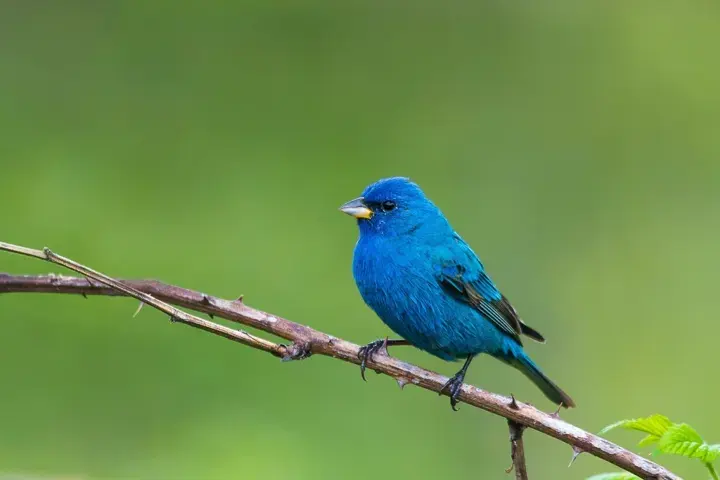
Male: Deep blue all over in spring and summer.
Female: Brown with fine streaks on the chest and a blue tinge on the tail.
Young birds: One-year-old males may be blue with a white belly.
Size: 5.1 in (13 cm)
On camera
Getting the indigo bunting on a feeder camera
Any seed camera feeder works. Hang it near shrubs for cover, about five feet off the ground, with the lens facing away from direct sun.
Questions
Indigo Bunting: questions
What do indigo buntings eat?
At feeders, nyjer, millet, seed mixes.
Do indigo buntings migrate?
Migrant. Across the US, sightings start in April, peak in July and fade out in October.
Where do indigo buntings live?
By share of all bird sightings, they are most common in Arkansas, Missouri, Kentucky, Iowa, Tennessee. They are rare or absent in Alaska, Arizona, California, Colorado, Hawaii, Idaho.
What does a female indigo bunting look like?
Brown with fine streaks on the chest and a blue tinge on the tail.